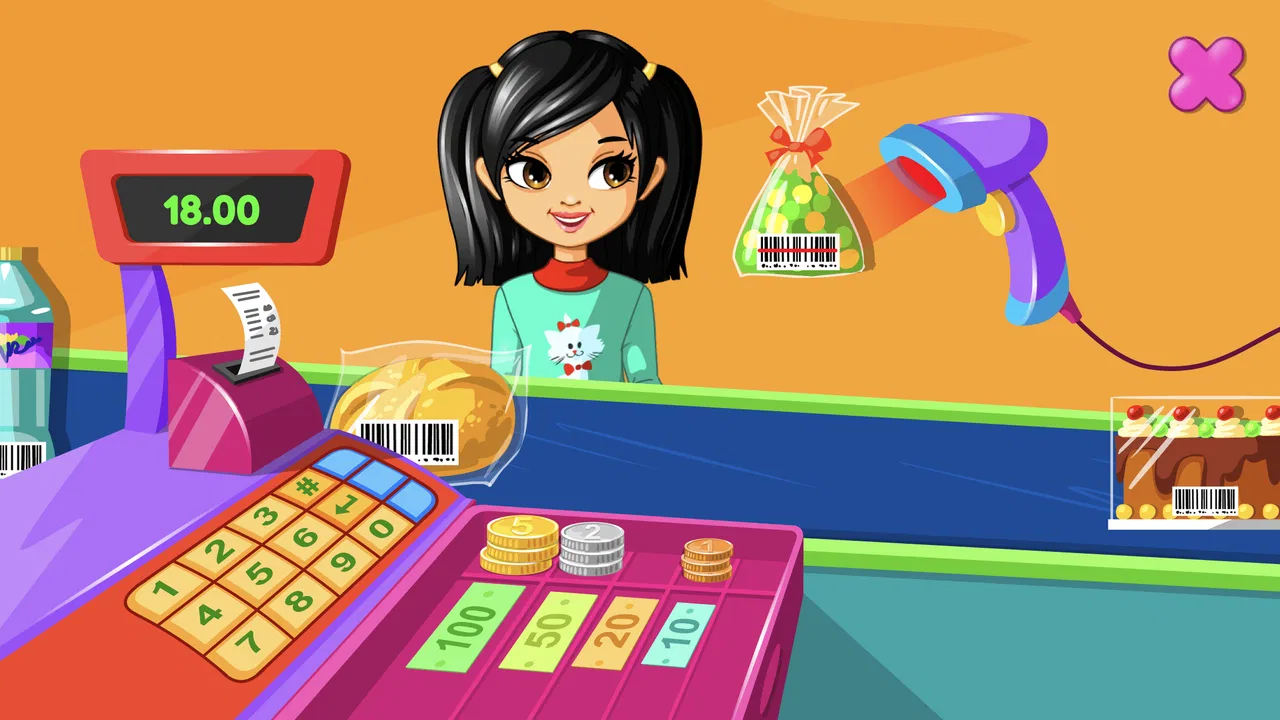
Supermarket Game
- 4.0
- Rating
- 100.00M
- Installs
- Free
- Price

 Analysis by App-foxy
I spent time with Supermarket Game as a light, casual shopping-management game, and my first impression was easy to understand: it wants to turn the ordinary work of running a store into a quick series of small decisions. You are not dealing with a complicated business simulator or a long strategy campaign. The appeal is the rhythm of serving customers, keeping the market moving, and trying to become more successful as the activity builds.
That simple idea is a good fit for short sessions. I can imagine opening it while waiting for an appointment, playing for a few minutes, and putting it away without feeling that I have abandoned a demanding project. At the same time, the game has enough structure to give those short sessions a purpose. The important question is whether its goals and progress remain interesting after the novelty of the supermarket setting fades. In my experience, that depends heavily on whether you enjoy repetition with small improvements rather than dramatic changes.
How the first goals pull you into the supermarket routine
The opening appeal comes from having a job to do immediately. Instead of asking me to learn a large collection of menus or complicated economic rules, the game places the supermarket idea at the center and lets the activity explain itself. That makes it approachable for younger players and for anyone who prefers casual games that do not require a tutorial session before the fun begins.
You May Also Like

 AccuWeather: Weather Radar
AccuWeather Review: A Quick, Clear Forecast for Everyday Decisions
For everyday plans, the best forecast is the one you can understand quickly. AccuWeather makes rain timing, radar, and local conditions easy to act on, with a few trade-offs.

 Hill Climb Racing
Why Hill Climb Racing Still Turns Crashes Into One More Run
A tiny car, a bumpy hill and one more upgrade: Hill Climb Racing keeps resurfacing because its simple chaos makes every near-miss feel personal.

 AliExpress - Shopping App
AliExpress Makes Global Shopping Feel Personal, but Shoppers Bear the Risk
AliExpress turns a global marketplace into a pocket-sized discovery engine. Its reach is useful, its shopping loop compelling, and its trade-offs easy to miss.

 Lords Mobile: Kingdom Wars
Lords Mobile Is a Kingdom-Building Routine, Not a Quick Match
A case-by-case verdict on the building, battles, device demands, and social commitments that make Lords Mobile rewarding for some players and exhausting for others.

 PDF Scanner app - TapScanner
TapScanner Makes Paperwork Easier to Capture, Check, and Share
TapScanner makes scanning with a phone feel less like a rescue operation and more like a dependable step in getting work done. Its capture tools are useful, though not flawless.

 Block Blast!
 Shows How Much a Puzzle Game Can Leave Out
A quiet grid game shows why puzzle players increasingly value instant clarity, repeatable skill and low-pressure play—and where the genre still needs to catch up.
More From Our News Desk
View All News


The early goals work best when I treat them as a sequence of manageable errands rather than as a grand business plan. I focus on what needs attention in front of me, complete that task, and then look for the next signal that the store is ready for another action. This creates a pleasant loop: observe the situation, respond to it, and see the market become more successful through continued attention.
One useful habit is to avoid rushing through every action simply because the game feels easy at first. The early section teaches the pace that the rest of the experience expects. I found it more helpful to notice which actions keep the store flowing and which ones interrupt that flow. That small distinction matters later, because casual management games can become less enjoyable when the player reacts randomly instead of building a reliable routine.
The supermarket theme also gives the early objectives a more familiar shape than many abstract casual games. A customer-facing task is easier to understand when it resembles something from everyday life. I do not need to know anything about finance or retail to recognize that a busy store needs attention. That familiarity is one of the game’s strongest entry points.
Still, the early stage is not designed for players who want a deep story or a large mystery to uncover. The motivation comes from activity and improvement, not from characters, plot twists, or exploration. If your ideal casual game is one with a narrative campaign, this may feel thin. If you like clear practical goals and quick feedback, the setup is much more inviting.
What progress feels like during ordinary play
The most satisfying part of the experience is the visible sense that my work has a result. A successful action is not just a button press; it contributes to the feeling that the supermarket is operating better. That connection between action and outcome is important because the game’s concept is otherwise very straightforward. Without that feedback, the routine would quickly feel like a checklist.
I recommend playing in small focused bursts rather than tapping through everything without looking. Casual games often hide their best sense of progress in the details: a smoother sequence, a better response to a customer situation, or the feeling that I am handling the store with less hesitation than before. Those are modest rewards, but they make the next session easier to start.
The progress signals are especially useful for players who do not want a punishing challenge. I can set a simple personal target, such as completing a session without losing track of the current priority, and use that as a reason to continue. The game does not need to overwhelm me with systems to make improvement noticeable. In fact, its lighter structure is part of why it works as a family-friendly pastime.
There is also a practical trade-off here. A player who expects each new stage to transform the game may find the progress less exciting than someone who enjoys gradual refinement. The satisfaction comes from becoming more comfortable with the routine, not necessarily from discovering an entirely different game every time I return.
Challenge, pacing, and the point where repetition matters
The challenge is best understood as attention management. I need to keep track of what is happening, decide what deserves priority, and avoid letting the supermarket routine become careless. That is a gentler form of difficulty than combat, timed puzzles, or competitive multiplayer, but it can still be engaging when the pace is active enough.
I found the game most enjoyable when I gave myself permission to slow down for a moment and identify the next useful action. Trying to play as quickly as possible is not always the best approach. Speed can feel exciting, but it can also turn a simple management task into frantic tapping. A steady rhythm usually gives me better control and makes the progress feel earned.
The difficulty curve is therefore more about increasing concentration than learning advanced strategy. That makes the game accessible, but it also limits its appeal for experienced players seeking demanding optimization. There is no reason to choose this over a more elaborate management simulator if you want detailed supply chains, staffing decisions, or long-term financial planning. Supermarket Game is aimed at a much lighter experience.
Another point worth considering is session length. The game suits a brief break because the central activity is easy to resume, but players who want a substantial evening of complex decision-making may run out of meaningful variety sooner. I would not approach it expecting the depth of a full retail simulation. I would approach it as a compact casual routine that can be revisited whenever I want something uncomplicated.
That pacing also makes it suitable for people who are new to management games. There is less pressure to understand a large strategic model, and the supermarket setting gives each action an intuitive context. For a child, a casual player, or someone who normally avoids strategy titles, that can be more important than having a huge number of mechanics.
Unlocks and progress without losing the simple appeal
Progression works here when it supports the central fantasy instead of burying it under menus. I want the feeling of building toward a more successful market, but I do not want the game to make every small step feel like administration. The best moments are the ones where progress encourages me to continue while keeping the supermarket activity at the front.
My advice is to judge progress by how much it changes your motivation, not only by how many new items or milestones appear. A useful unlock should give me a reason to try another session or approach the next task differently. If it merely adds another layer to tap through, the reward feels less meaningful. This is a general risk in casual progression, and it is particularly noticeable in a game built around a repeated everyday activity.
The game’s broad audience helps explain its restrained approach. It is free to play, carries an Everyone age rating, and comes from FM by Bubadu, a developer associated here with a family-friendly casual style. Those details make it easier to recommend as a low-commitment game for a shared device, although parents should still remember that optional in-app purchases are available.
The purchase structure is worth handling thoughtfully. Individual in-app purchases range from $0.99 to $3.99, so I would treat them as optional convenience spending rather than part of the basic reason to install the game. For a child using a family device, I would check the purchase settings before handing it over. The game can be approached as a free experience, but the presence of paid options means the player should know where the boundaries are.
One of the more useful ways to play is to decide in advance whether you are willing to spend anything. If the answer is no, concentrate on the free progression and accept that the game’s pace may be designed to encourage patience. If the answer is yes, keep purchases tied to a clear reason instead of buying impulsively after a frustrating moment. That approach protects the casual nature of the experience and prevents a small game from becoming an unnecessary expense.
Does the retention loop stay interesting?
The game encourages return visits through the familiar promise of doing a little more with the supermarket. That can be enough for players who enjoy incremental progress, especially when they like seeing a simple routine become more efficient. I often find this kind of design relaxing because it gives me a clear place to focus without demanding total concentration for a long period.
However, retention pressure can feel different from genuine curiosity. If I return because I am interested in the next improvement, the loop feels rewarding. If I return only because I feel I should finish one more task, the same loop can become mechanical. That distinction is important when deciding whether this game will last on your device. It is not a title I would recommend solely because it is popular; I would recommend it to someone who already enjoys casual management repetition.
The game has reached over 100 million installs and holds a 4.0 average from around 271 thousand ratings, which suggests that its straightforward concept has connected with a large audience. Those figures do not guarantee that every player will enjoy the pacing, but they do help place the game correctly: this is an established, accessible casual title rather than a niche simulation built for a small group of experts.
Its release on July 11, 2016, also matters when setting expectations. The game has had time to become familiar to a broad audience, but I would not compare its presentation or design assumptions directly with every newer mobile release. The current version is 1.64, and it requires Android 6.0 or later. For someone using a compatible Android device, that makes it a practical older casual game to try, particularly if they value a known, simple format over the newest visual style.
There is a hidden benefit to that maturity: the core idea is easy to understand without needing to follow current genre trends. There is also a limitation: players accustomed to modern games with constant events, elaborate customization, or highly reactive worlds may find the experience modest. I see that as a matter of preference rather than a flaw, but it should shape your expectations before downloading.
Who should play it, and who should choose something else?
I would recommend it to a player who wants a casual supermarket game with an immediate premise, light management decisions, and a progression loop that can be enjoyed in short visits. It is a good candidate for a family tablet, a quick break during the day, or anyone who likes the satisfaction of keeping a small operation moving without studying a complicated rulebook.
A realistic use case would be a ten-minute wait before an appointment. I can open the game, handle the current supermarket tasks, aim for a clean sequence of actions, and stop when my time is up. I do not need to remember a long story or rebuild a complex plan later. That low memory burden is one of its strongest practical advantages.
I would be more cautious about recommending it to someone who wants detailed economics, competitive rankings, deep customization, or a strong narrative. A dedicated business simulator will offer more meaningful long-term planning. A puzzle game may provide sharper moment-to-moment challenge. A tycoon game may give a stronger sense of expansion and consequence. Supermarket Game is better when the goal is gentle activity, not maximum strategic depth.
It is also not the right choice if optional purchases would create tension in your household. The free entry is appealing, but any game with in-app purchases deserves sensible device controls, especially when younger players are involved. The Everyone rating makes the content broadly approachable, yet age suitability does not remove the need for responsible spending settings.
My verdict on the goals and long-term pacing
After looking at the way goals, progress, and challenge work together, I see Supermarket Game as a dependable casual title rather than an ambitious simulation. Its early objectives are clear, its feedback makes ordinary actions feel worthwhile, and its gentle difficulty curve keeps the experience welcoming. The progression is most effective when I enjoy gradual improvement and do not demand a dramatic reinvention of the supermarket from one session to the next.
The main weakness is the same quality that makes it accessible: simplicity. Players who need constant novelty may find the repeated routine loses energy. The retention loop can support regular play, but it works best for people who genuinely like incremental tasks instead of those who are only chasing the next reward. Optional purchases also mean I would play with spending boundaries in mind.
For me, the final decision is straightforward. I would install this free casual game when I wanted a friendly, low-pressure supermarket experience that fits around the rest of my day. I would skip it in favor of a deeper management game when I wanted complex planning or a serious challenge. With its Everyone rating, broad install history, 4.0 average, and support for Android 6.0 and later, it is easy to try; the real question is whether its steady rhythm matches the way you like to play.
My recommendation: choose it for short, relaxed sessions and gradual progress, but do not expect a full retail simulator. That is where the game is most honest and most enjoyable. When I treat it as a compact supermarket routine instead of a massive business strategy experience, its goals and pacing make much more sense.
FAQs for Supermarket Game
01What is the main objective of the Supermarket Game?
The Supermarket Game is designed to provide a fun and educational shopping simulation experience. Players are tasked with managing a virtual supermarket, stocking shelves, assisting customers, and ensuring the store runs smoothly. It's a mix of time management and strategy, making it engaging for players of all ages.
02Is the Supermarket Game suitable for children?
Yes, the Supermarket Game is family-friendly and suitable for children. It incorporates educational elements such as math skills, decision-making, and time management. The colorful graphics and easy-to-understand mechanics make it accessible for younger audiences, while still being challenging enough for adults.
03Does the Supermarket Game require an internet connection to play?
The Supermarket Game can be played offline, making it convenient for users who may not always have access to the internet. However, certain features, such as leaderboards or special events, may require an online connection to enhance the gaming experience.
04Are there in-app purchases in the Supermarket Game?
Yes, the Supermarket Game includes in-app purchases that allow players to buy virtual currency or special items to enhance their gameplay. While these purchases can accelerate progress, they are not necessary to enjoy the full experience of the game, as it is designed to be enjoyable without spending extra money.
05What devices are compatible with the Supermarket Game?
The Supermarket Game is available for both Android and iOS devices. It supports a wide range of smartphones and tablets, but it's recommended to check the specific device requirements on the app store page to ensure optimal performance and compatibility.
Pros
- Engaging gameplay for all ages.
- Colorful and vibrant graphics.
- Simple controls
- easy to learn.
- Variety of levels and challenges.
- Offline mode available.
Cons
- Ads can be intrusive.
- Limited character customization.
- In-app purchases can add up.
- Occasional performance lags.
- Requires frequent updates.

Supermarket Game
Gallery